


Файл:Potw1303a.jpg

Исходный файл (1920 × 1440 пкс, размер файла: 773 КБ, MIME-тип: image/jpeg)
Описание
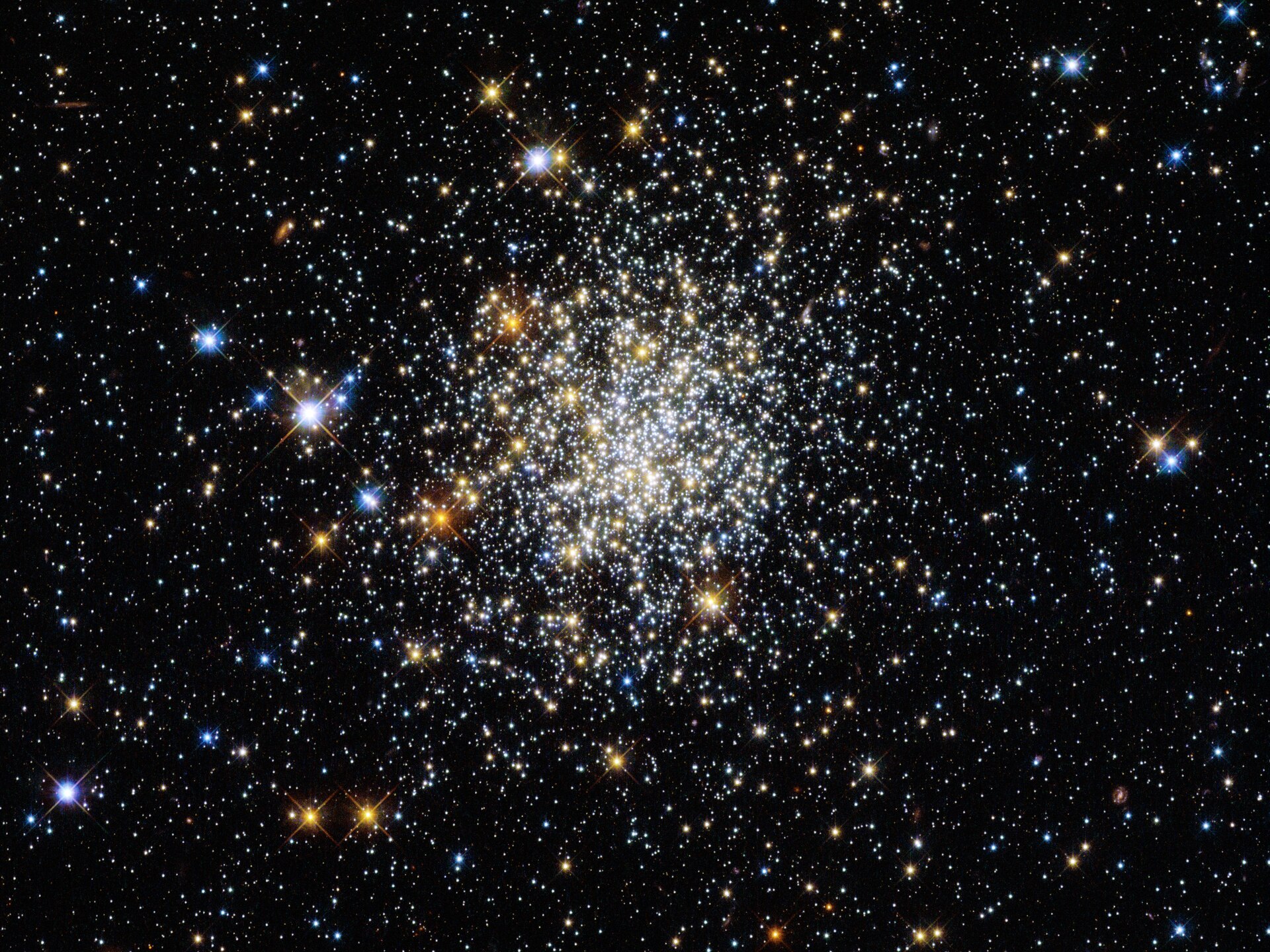
| Описание | Appearances can be deceptive
And yet appearances can be deceptive: NGC 411 is in fact not a globular cluster, and its stars are not old. It isn’t even in the Milky Way. NGC 411 is classified as an open cluster. Less tightly bound than a globular cluster, the stars in open clusters tend to drift apart over time as they age, whereas globulars have survived for well over 10 billion years of galactic history. NGC 411 is a relative youngster — not much more than a tenth of this age. Far from being a relic of the early years of the Universe, the stars in NGC 411 are in fact a fraction of the age of the Sun. The stars in NGC 411 are all roughly the same age, having formed in one go from one cloud of gas. But they are not all the same size. Hubble’s image shows a wide range of colours and brightnesses in the cluster’s stars. These tell astronomers many facts about the stars, including their mass, temperature and evolutionary phase. Blue stars, for instance, have higher surface temperatures than red ones. The image is a composite produced from ultraviolet, visible and infrared observations made by Hubble’s Wide Field Camera 3. This filter set lets the telescope “see” colours slightly further beyond red and the violet ends of the spectrum. Credit: ESA/Hubble & NASA About the Object Name: NGC 411 Type: • Local Universe : Star : Grouping : Cluster : Open Distance: 200000 light years Colours & filters Band Wavelength Telescope Ultraviolet U 336 nm Hubble Space Telescope WFC3 Optical B 475 nm Hubble Space Telescope WFC3 Infrared I 814 nm Hubble Space Telescope WFC3 . |
|---|---|
| Источник | http://www.spacetelescope.org/images/potw1303a/ direct link: http://www.spacetelescope.org/static/archives/images/original/potw1303a.tif |
| Время создания | 2013-01-21 10:00 |
| Автор или правообладатель | Credit: ESA/Hubble & NASA — Лицензия: CC BY 3.0 (Creative Commons Attribution 3.0) https://creativecommons.org/licenses/by/3.0 |
| Другие версии файла | — |
Источник файла — сайт Wikimedia Commons, куда он был загружен под одной из свободных лицензий ( https://commons.wikimedia.org/wiki/File:Potw1303a.tif ). Авторов, работавших над этим файлом см. в истории файла: https://commons.wikimedia.org/w/index.php?title=File:Potw1303a.tif&action=history
В общем случае в статьях энциклопедии Руниверсалис файлы используются в соответствии со статьёй 1274 Гражданского кодекса Российской Федерации.
История файла
Нажмите на дату/время, чтобы увидеть версию файла от того времени.
| Дата/время | Миниатюра | Размеры | Участник | Примечание | |
|---|---|---|---|---|---|
| текущий | 13:26, 5 марта 2026 | | 1920 × 1440 (773 КБ) | Io, robot (обсуждение | вклад) | == Описание == {{Изображение | описание = <b>Appearances can be deceptive</b> <p><br/> Globular clusters are roughly spherical collections of extremely old stars, and around 150 of them are scattered around our galaxy. Hubble is one of the best telescopes for studying these, as its extremely high resolution lets astronomers see individual stars, even in the crowded core. The clusters all look very similar, and in Hubble’s images it can be quite hard to tell them apart – and they all look muc... |
Вы не можете перезаписать этот файл.
Использование файла
Следующие 3 страницы используют этот файл:
- NGC 411
- Файл:Potw1303a.tif (файловое перенаправление)
