


Файл:PIA18316-SaturnMoon-Rhea-Cassini-20150210.jpg

Исходный файл (1020 × 1020 пкс, размер файла: 143 КБ, MIME-тип: image/jpeg)
Описание
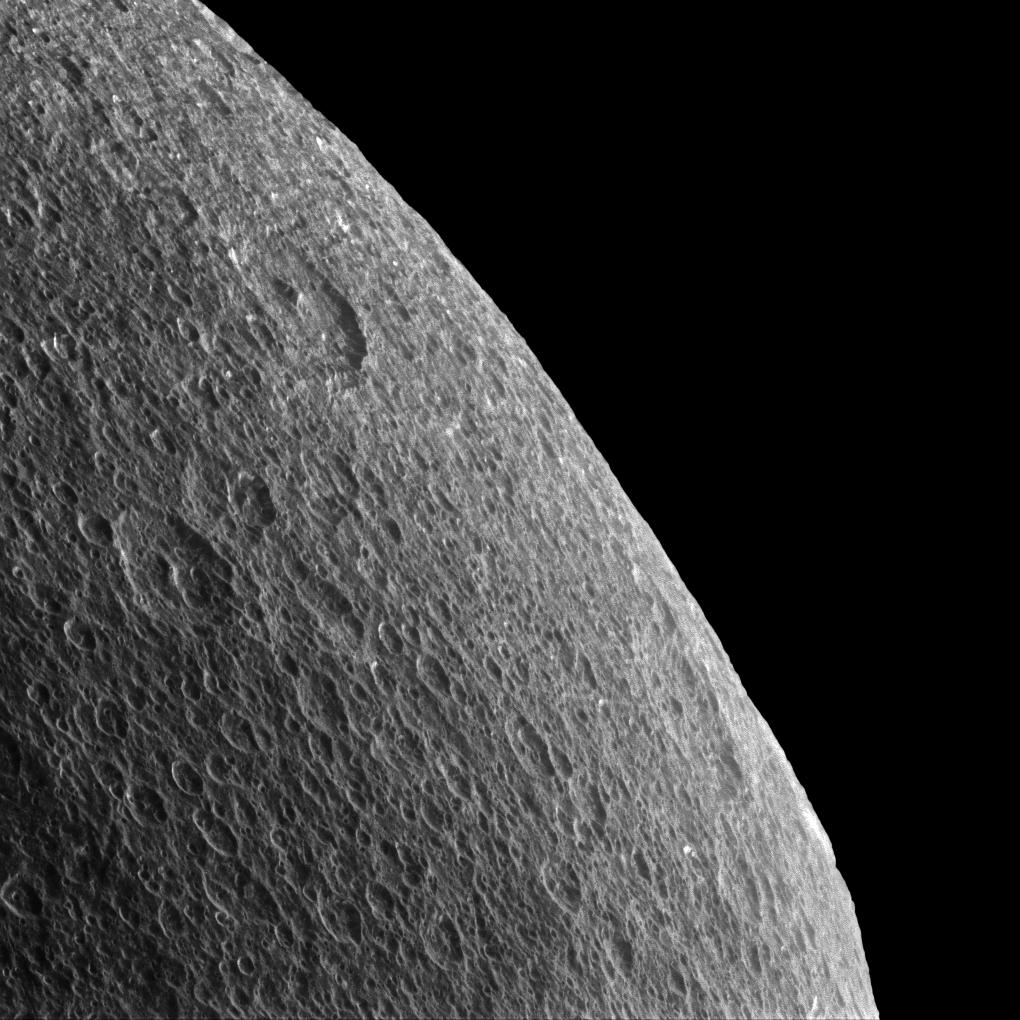
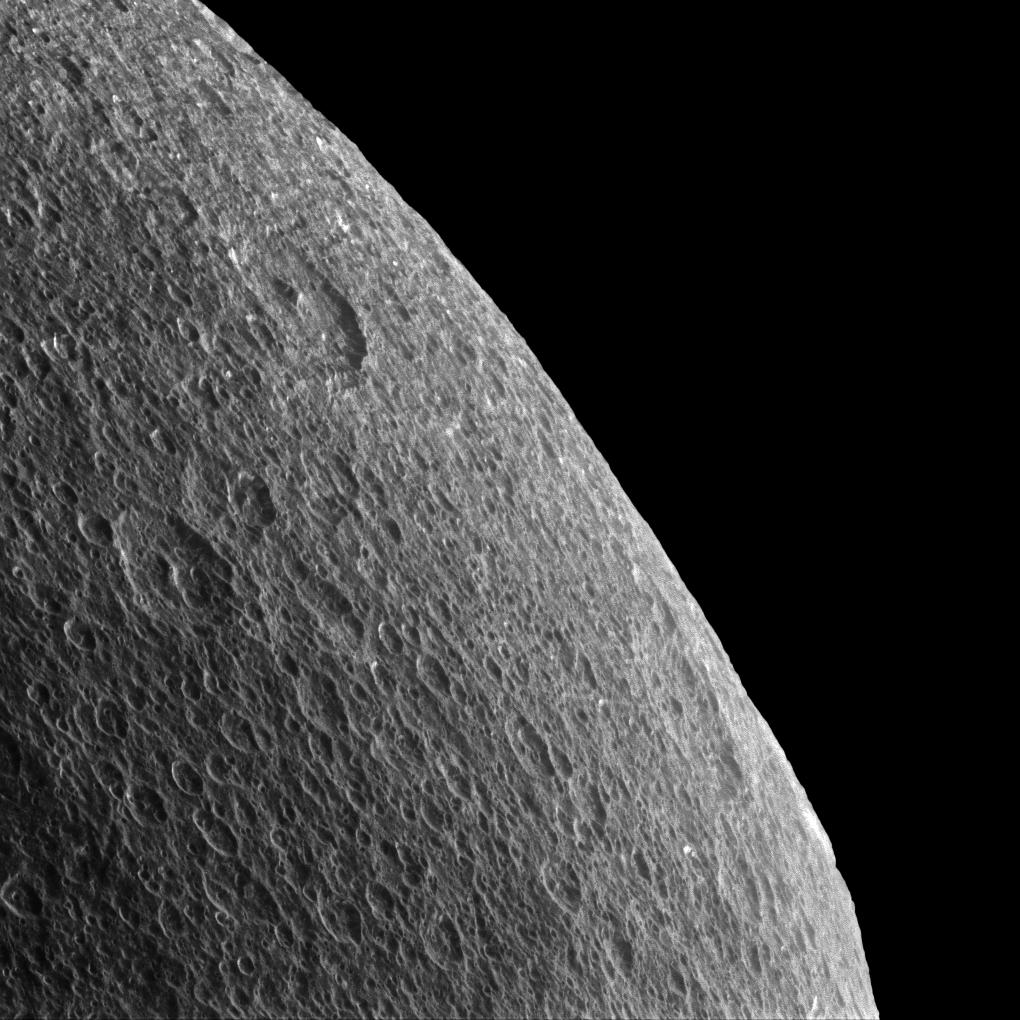
| Описание | PIA18316: Rhea's Horizon
http://photojournal.jpl.nasa.gov/catalog/PIA18316 Rhea's horizon is slightly irregular and battered by craters, so thoughts inevitably turn towards the forces that shape these icy worlds. This image is from NASA's Cassini spacecraft. Gazing off toward the horizon is thought-provoking no matter what body's horizon it is. Rhea's horizon is slightly irregular and battered by craters, so thoughts inevitably turn towards the forces that shape these icy worlds. The surface of Rhea (949 miles or 1527 kilometers across) has been sculpted largely by impact cratering, each crater a reminder of a collision sometime in the moon's history. On more geologically active worlds like Earth, the craters would be erased by erosion, volcanoes or tectonics. But on quieter worlds like Rhea, the craters remain until they are disrupted or covered up by the ejecta of a subsequent impact. Lit terrain seen here is on the trailing hemisphere of Rhea. North on Rhea is up and rotated 12 degrees to the right. In this view, Cassini was at a subspacecraft latitude of 9 degrees North. The image was taken in visible light with the Cassini spacecraft narrow-angle camera on Feb. 10, 2015. The view was obtained at a distance of approximately 35,000 miles (56,000 kilometers) from Rhea and at a Sun-Rhea-spacecraft, or phase, angle of 76 degrees. Image scale is 1,100 feet (330 meters) per pixel. The Cassini mission is a cooperative project of NASA, ESA (the European Space Agency) and the Italian Space Agency. The Jet Propulsion Laboratory, a division of the California Institute of Technology in Pasadena, manages the mission for NASA's Science Mission Directorate, Washington. The Cassini orbiter and its two onboard cameras were designed, developed and assembled at JPL. The imaging operations center is based at the Space Science Institute in Boulder, Colorado. For more information about the Cassini-Huygens mission visit http://saturn.jpl.nasa.gov and http://www.nasa.gov/cassini. The Cassini imaging team homepage is at http://ciclops.org. |
|---|---|
| Источник | http://photojournal.jpl.nasa.gov/jpeg/PIA18316.jpg |
| Время создания | 2015-02-10 |
| Автор или правообладатель | NASA/JPL-Caltech/Space Science Institute — Лицензия: Public domain (в общественном достоянии) |
| Другие версии файла | — |
Источник файла — сайт Wikimedia Commons, куда он был загружен под одной из свободных лицензий ( https://commons.wikimedia.org/wiki/File:PIA18316-SaturnMoon-Rhea-Cassini-20150210.jpg ). Авторов, работавших над этим файлом см. в истории файла: https://commons.wikimedia.org/w/index.php?title=File:PIA18316-SaturnMoon-Rhea-Cassini-20150210.jpg&action=history


В общем случае в статьях энциклопедии Руниверсалис файлы используются в соответствии со статьёй 1274 Гражданского кодекса Российской Федерации.
История файла
Нажмите на дату/время, чтобы увидеть версию файла от того времени.
| Дата/время | Миниатюра | Размеры | Участник | Примечание | |
|---|---|---|---|---|---|
| текущий | 20:25, 15 декабря 2023 | | 1020 × 1020 (143 КБ) | I, Robot (обсуждение | вклад) | == Описание == {{Изображение | описание = PIA18316: Rhea's Horizon <p>[http://photojournal.jpl.nasa.gov/catalog/PIA18316 http://photojournal.jpl.nasa.gov/catalog/PIA18316] </p><p>Rhea's horizon is slightly irregular and battered by craters, so thoughts inevitably turn towards the forces that shape these icy worlds. This image is from NASA's Cassini spacecraft. </p><p>Gazing off toward the horizon is thought-provoking no matter what body's horizon it is. Rhea's horizon is slightly irregular... |
Вы не можете перезаписать этот файл.
Использование файла
Следующий файл является дубликатом этого файла (подробности):

- Файл:PIA18316-SaturnMoon-Rhea-Cassini-20150210.jpg на Викискладе
Следующая страница использует этот файл:
