


Файл:Mountain scops owl.jpg
Mountain_scops_owl.jpg (640 × 429 пкс, размер файла: 91 КБ, MIME-тип: image/jpeg)
Описание
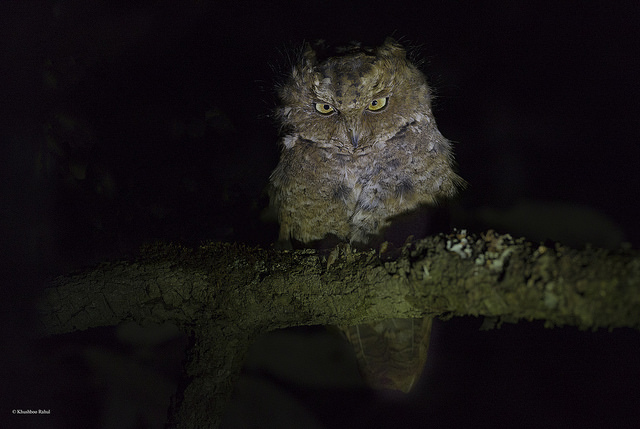
| Описание | Mountain Scops Owl Is a nocturnal bird, starting its activity during and after dusk. Frequents deep and shady gullies and ravines, foraging in the lower parts of the densest forest trees.
There are many different colour morphs, as well as considerable individual variation in colour. The facial disc is rufous-brown with conspicuous bristles. The bristly feathers are pale at the base and tipped blackish. The eyes are golden-yellow or greenish-yellow. The bill is pale horn-coloured, whitish, or wax-yellow. Ear-coverts and cheeks are barred blackish, while the collar is whitish or rufous-buff with obscure bars of blackish and dark brown or blackish tips. The forehead and sides of the crown, including the short ear-tufts, are sometimes paler and buffish, with the crown having many pale rufous spots edged with black that often broaden on the hindneck and back into bars. Upper parts are dark tawny-brown or rufous-brown, vermiculated with blackish. Inner scapulars form a prominent row of feathers with clear white outer webs and bold black tips. The median wing-coverts are usually boldly marked with buff and black. The primaries are barred rufous-brown and dark brown. The tail is rufous-brown with blackish bars mottled and broken by chestnut bands. Underparts are whitish, barred rufous with small triangular paired black and white spots. Tarsi are densely feathered up to and often over the base of the toes, which are whitish to pale flesh, or fleshy-brown. The population size has not been quantified, but it is not believed to approach the thresholds for Vulnerable under the population size criterion (<10,000 mature individuals with a continuing decline estimated to be >10% in ten years or three generations, or with a specified population structure). For these reasons the species is evaluated as Least Concern . The eight recognized subspecies of mountain scops-owl are: O. s. luciae (Sharpe, 1888), O. s. vandewateri (Robinson & Kloss, 1916), O. s. vulpes (Ogilvie-Grant, 1906), O. s. siamensis Robinson & Kloss, 1922, O. s. hambroecki (Swinhoe, 1870), O. s. latouchi (Rickett, 1900), O. s. spilocephalus (Blyth, 1846) and O. s. huttoni (A. O. Hume, 1870). The species Otus spilocephalus is considered close to species O. balli, O. alfredi, O. angelinae and O. longicornis. The mountain scops-owl subspecies O. s. huttoni is distributed in Himalayan foothills in Pakistan, India and Nepal. The subspecies O. s. spilocephalus is distributed in Nepal, Northeast India and Northwest Myanmar. The subspecies O. s. latouchi is distributed in North Thailand, Laos, Southeast China and Hainan province (China) in the South China Sea. The subspecies O. s. hambroecki is distributed in Taiwan. The subspecies O. s. siamensis is distributed in Thailand and Vietnam. The subspecies O. s. vulpes is distributed in Malay Peninsula (Southern tip of Thailand and Malaysia). The subspecies O. s. vandewateri is distributed in Sumatra Islands (Indonesia). The subspecies O. s. luciae is distributed in Borneo Islands (Indonesia). Mountain scops-owl ecosystem and habitat The mountain scops-owl ecosystem includes evergreen, montane forests predominantly with chestnut, oak, pine and Rhododendron species. Diet and feeding habits The diet of these owl species mostly consists of large insects like cicadas, grasshoppers, mantises, beetles and moths. They have been observed to feed on small rodents, lizards and birds. Reproduction and breeding habits The breeding season of mountain scops-owl is from March to June in India and Pakistan. They nest in tree hollows and abandoned woodpecker nests. The nest is unlined. The clutch may contain up to five eggs. Movement and migration patterns These owl species are mostly sedentary and are residents in their range. Post breeding dispersal of juveniles takes place. In the Himalayas, these mountain scops-owl species descend to lower ranges and valleys in winter. They may make local movements for feeding and breeding. |
|---|---|
| Источник | Own work |
| Время создания | 2017-10-17 |
| Автор или правообладатель | Rahul sharma Indiansavanna — Лицензия: CC BY-SA 4.0 (Creative Commons Attribution-Share Alike 4.0) https://creativecommons.org/licenses/by-sa/4.0 |
| Другие версии файла | — |
Источник файла — сайт Wikimedia Commons, куда он был загружен под одной из свободных лицензий ( https://commons.wikimedia.org/wiki/File:Mountain_scops_owl.jpg ). Авторов, работавших над этим файлом см. в истории файла: https://commons.wikimedia.org/w/index.php?title=File:Mountain_scops_owl.jpg&action=history


В общем случае в статьях энциклопедии Руниверсалис файлы используются в соответствии со статьёй 1274 Гражданского кодекса Российской Федерации.
История файла
Нажмите на дату/время, чтобы увидеть версию файла от того времени.
| Дата/время | Миниатюра | Размеры | Участник | Примечание | |
|---|---|---|---|---|---|
| текущий | 20:25, 19 ноября 2023 | | 640 × 429 (91 КБ) | I, Robot (обсуждение | вклад) | == Описание == {{Изображение | описание = Mountain Scops Owl Is a nocturnal bird, starting its activity during and after dusk. Frequents deep and shady gullies and ravines, foraging in the lower parts of the densest forest trees. <p>There are many different colour morphs, as well as considerable individual variation in colour. The facial disc is rufous-brown with conspicuous bristles. The bristly feathers are pale at the base and tipped blackish. The eyes are golden-yellow or greenish-yellow... |
Вы не можете перезаписать этот файл.
Использование файла
Следующий файл является дубликатом этого файла (подробности):

- Файл:Mountain scops owl.jpg на общем хранилище
Следующая страница использует этот файл:
