


Файл:Univex Mercury CC-1500.jpg

Исходный файл (1279 × 984 пкс, размер файла: 779 КБ, MIME-тип: image/jpeg)
Описание
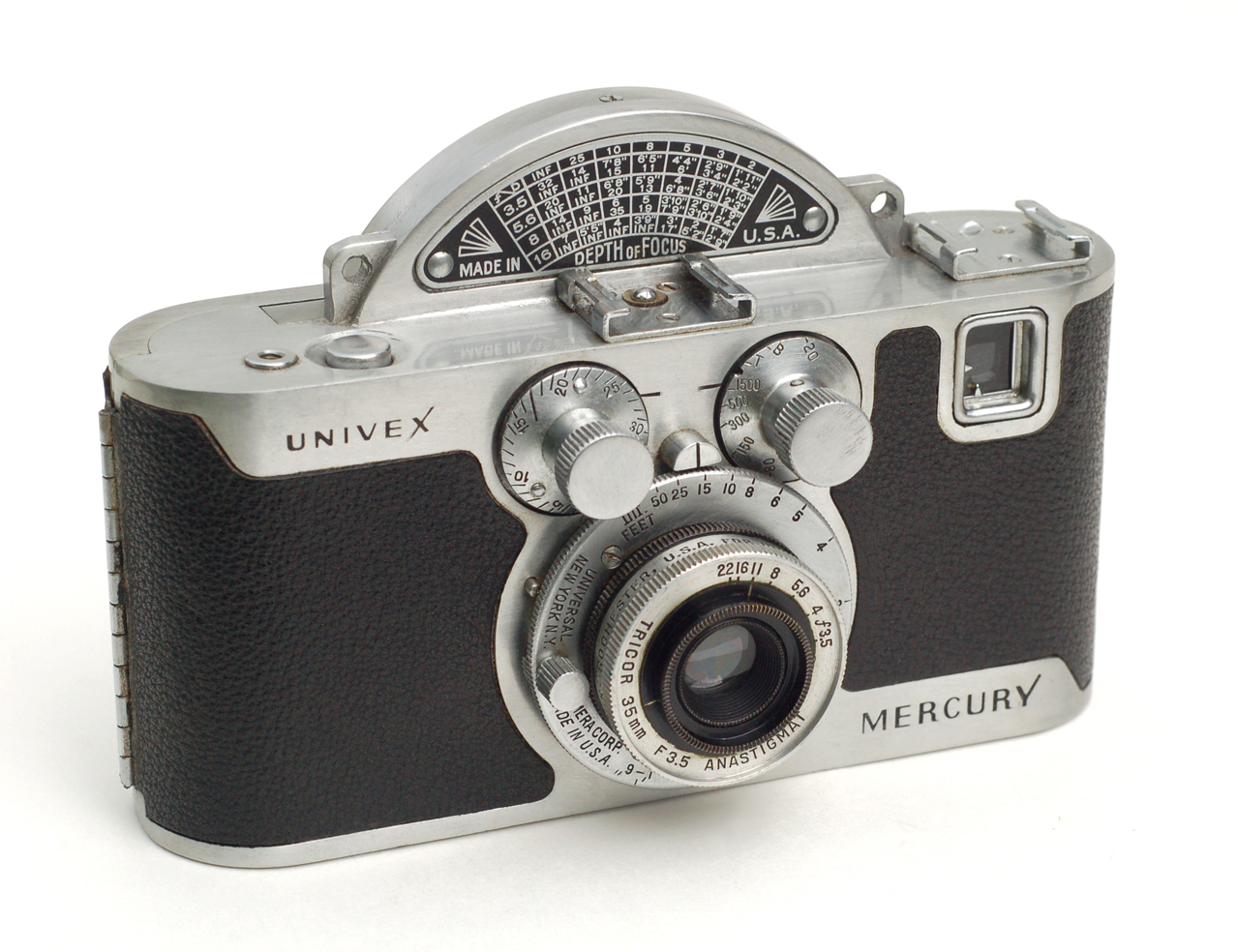
| Описание | The Universal Camera Corporation found great success in the early/mid 1930s by selling very inexpensive cameras and film. By the late 30s, however, the camera-buying public had shown an increasing interest in high-end imports such as the Leica and Contax lines, and the simple plastic still cameras offered by Universal up to that point were no competition. Universal rectified the matter in October of 1938, with the release of the Univex Mercury (Model CC). Cast from an aluminum alloy and covered with leather, the Mercury was not only unlike anything Universal had offered before, it was actually a revolutionary achievement in the industry. I won't go into all the features, but two are worth noting: First was the unique rotary shutter (responsible for the circular protrusion on top of the camera), capable of extremely accurate speeds up to 1/1000th of a second. Secondly, the Mercury was the first camera to have internal flash synchronization, known today as the hot shoe. German-made cameras from Leitz and Zeiss were selling for hundreds of dollars, making the American-made Mercury a VERY appealing alternative at a mere $25. Nonetheless, producing America's fastest candid camera did not satisfy Universal, as the Contax II claimed a shutter speed of 1/1250. Thus, in June of 1939, Universal introduced the Mercury Model CC-1500, named after its top shutter speed. For collectors, the CC-1500 is a rare find, as only (an estimated) 3,000 were manufactured, compared to approximately 45,000 of the standard Mercury Model CC. The example pictured here is equipped with a Wollensak f/3.5 Tricor lens, and sold new in 1939 for $29.75. The camera was also available with a Hexar f2.0 lens (rare today), an option that more than doubled the price of the outfit to a whopping $65! If you're still reading this and, for some reason, would like to know more, click on over to this page at Rick Oleson's site. |
|---|---|
| Источник | Univex Mercury CC-1500 |
| Время создания | 2009-05-06 18:34 |
| Автор или правообладатель | John Kratz from Burlington NJ, USA — Лицензия: CC BY-SA 2.0 (Creative Commons Attribution-Share Alike 2.0) https://creativecommons.org/licenses/by-sa/2.0 |
| Другие версии файла | — |
Источник файла — сайт Wikimedia Commons, куда он был загружен под одной из свободных лицензий ( https://commons.wikimedia.org/wiki/File:Univex_Mercury_CC-1500.jpg ). Авторов, работавших над этим файлом см. в истории файла: https://commons.wikimedia.org/w/index.php?title=File:Univex_Mercury_CC-1500.jpg&action=history


В общем случае в статьях энциклопедии Руниверсалис файлы используются в соответствии со статьёй 1274 Гражданского кодекса Российской Федерации.
История файла
Нажмите на дату/время, чтобы увидеть версию файла от того времени.
| Дата/время | Миниатюра | Размеры | Участник | Примечание | |
|---|---|---|---|---|---|
| текущий | 17:56, 3 сентября 2023 | | 1279 × 984 (779 КБ) | I, Robot (обсуждение | вклад) | == Описание == {{Изображение | описание = <p>The Universal Camera Corporation found great success in the early/mid 1930s by selling very inexpensive cameras and film. By the late 30s, however, the camera-buying public had shown an increasing interest in high-end imports such as the Leica and Contax lines, and the simple plastic still cameras offered by Universal up to that point were no competition. Universal rectified the matter in October of 1938, with the release of the Univex Mercury (Mo... |
Вы не можете перезаписать этот файл.
Использование файла
Следующий файл является дубликатом этого файла (подробности):

- Файл:Univex Mercury CC-1500.jpg на общем хранилище
Следующие 2 страницы используют этот файл:
