


Файл:Tiger's eye quartz 8.jpg

Исходный файл (1280 × 1484 пкс, размер файла: 723 КБ, MIME-тип: image/jpeg)
Описание
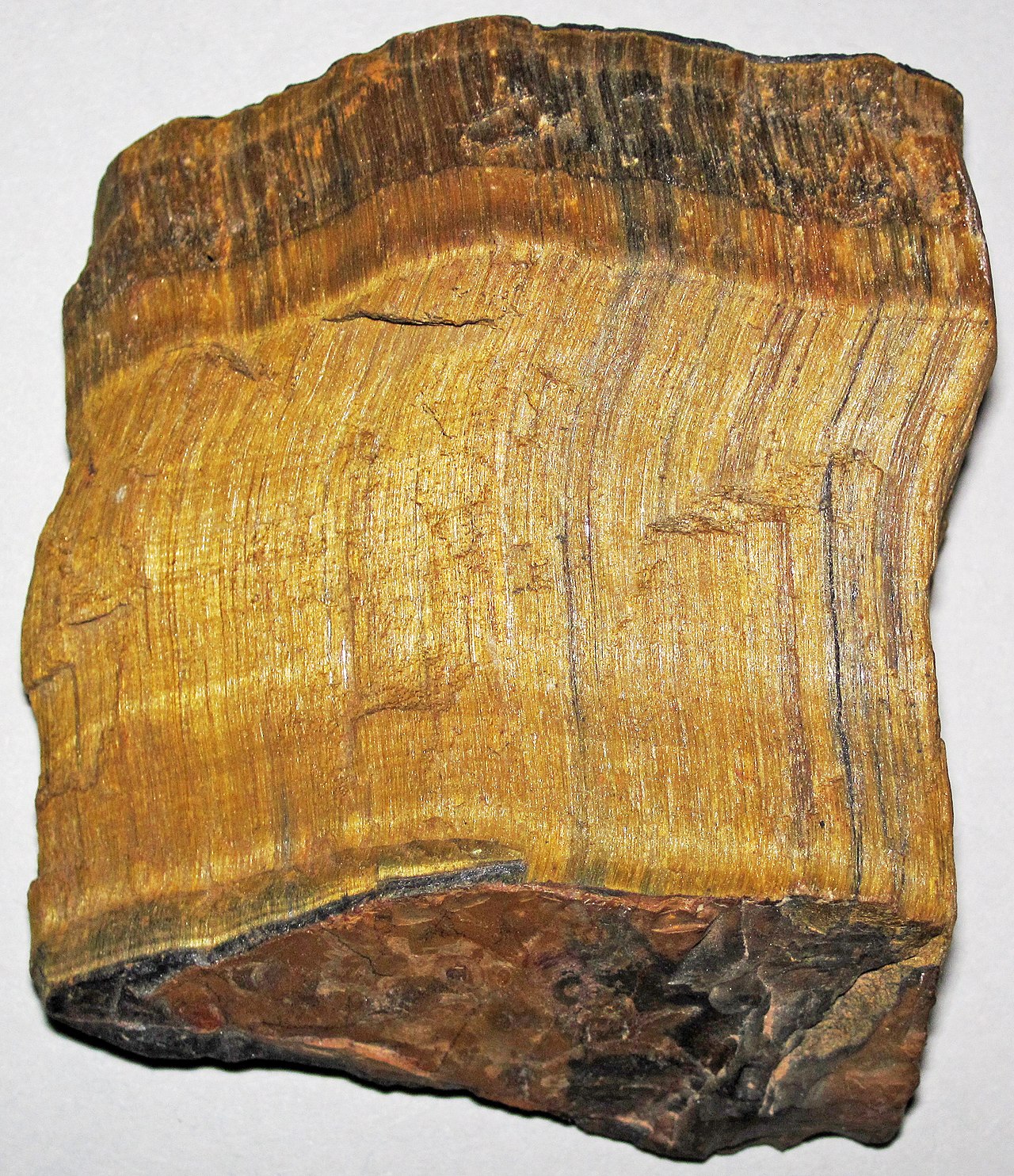
| Описание | Tiger's eye quartz (rough; ~5.0 centimeters across at its widest)
A mineral is a naturally-occurring, solid, inorganic, crystalline substance having a fairly definite chemical composition and having fairly definite physical properties. At its simplest, a mineral is a naturally-occurring solid chemical. Currently, there are over 5600 named and described minerals - about 200 of them are common and about 20 of them are very common. Mineral classification is based on anion chemistry. Major categories of minerals are: elements, sulfides, oxides, halides, carbonates, sulfates, phosphates, and silicates. The silicates are the most abundant and chemically complex group of minerals. All silicates have silica as the basis for their chemistry. "Silica" refers to SiO2 chemistry. The fundamental molecular unit of silica is one small silicon atom surrounded by four large oxygen atoms in the shape of a triangular pyramid - this is the silica tetrahedron - SiO4. Each oxygen atom is shared by two silicon atoms, so only half of the four oxygens "belong" to each silicon. The resulting formula for silica is thus SiO2, not SiO4. The simplest & most abundant silicate mineral in the Earth's crust is quartz (SiO2). All other silicates have silica + impurities. Many silicates have a significant percentage of aluminum (the aluminosilicates). Quartz (silicon dioxide/silica - SiO2) is the most common mineral in the Earth's crust. It is composed of the two most abundant elements in the crust - oxygen and silicon. It has a glassy, nonmetallic luster, is commonly clearish to whitish to grayish in color, has a white streak, is quite hard (H≡7), forms hexagonal crystals, has no cleavage, and has conchoidal fracture. Quartz can be any color: clear, white, gray, black, brown, pink, red, purple, blue, green, orange, etc. The specimen seen here is tiger's eye, a distinctive and attractive, semi-precious variety of quartz consisting of closely-packed, straight to slightly wavy fibers of quartz. The yellowish-brown coloration is apparently due to limonite (= hydrous iron hydroxy-oxide). Tiger's eye quartz has chatoyancy - tilting the specimen in bright light results in an optical effect of moving colors and varying light intensity. Tiger's eye quartz is traditionally hypothesized to have formed by quartz and limonite replacement of asbestiform amphibole. Another hypothesis, proposed in the 2000s, suggests that the quartz fibers grew perpendicular to the walls of a slowly-dilating fracture. Photo gallery of tiger's eye quartz: www.mindat.org/gallery.php?min=3960 |
|---|---|
| Источник | https://www.flickr.com/photos/47445767@N05/50903169636/ |
| Время создания | 2021-02-01 18:05:05 |
| Автор или правообладатель | James St. John — Лицензия: CC BY 2.0 (Creative Commons Attribution 2.0) https://creativecommons.org/licenses/by/2.0 |
| Другие версии файла | — |
Источник файла — сайт Wikimedia Commons, куда он был загружен под одной из свободных лицензий ( https://commons.wikimedia.org/wiki/File:Tiger's_eye_quartz_8.jpg ). Авторов, работавших над этим файлом см. в истории файла: https://commons.wikimedia.org/w/index.php?title=File:Tiger's_eye_quartz_8.jpg&action=history


В общем случае в статьях энциклопедии Руниверсалис файлы используются в соответствии со статьёй 1274 Гражданского кодекса Российской Федерации.
История файла
Нажмите на дату/время, чтобы увидеть версию файла от того времени.
| Дата/время | Миниатюра | Размеры | Участник | Примечание | |
|---|---|---|---|---|---|
| текущий | 17:58, 26 января 2026 | | 1280 × 1484 (723 КБ) | SubBot (обсуждение | вклад) | == Описание == {{Изображение | описание = Tiger's eye quartz (rough; ~5.0 centimeters across at its widest) <p>A mineral is a naturally-occurring, solid, inorganic, crystalline substance having a fairly definite chemical composition and having fairly definite physical properties. At its simplest, a mineral is a naturally-occurring solid chemical. Currently, there are over 5600 named and described minerals - about 200 of them are common and about 20 of them are very common. Mineral classif... |
Вы не можете перезаписать этот файл.
Использование файла
Следующая страница использует этот файл:
