


Файл:Pele Io I32.jpg

Исходный файл (800 × 623 пкс, размер файла: 96 КБ, MIME-тип: image/jpeg)
Описание
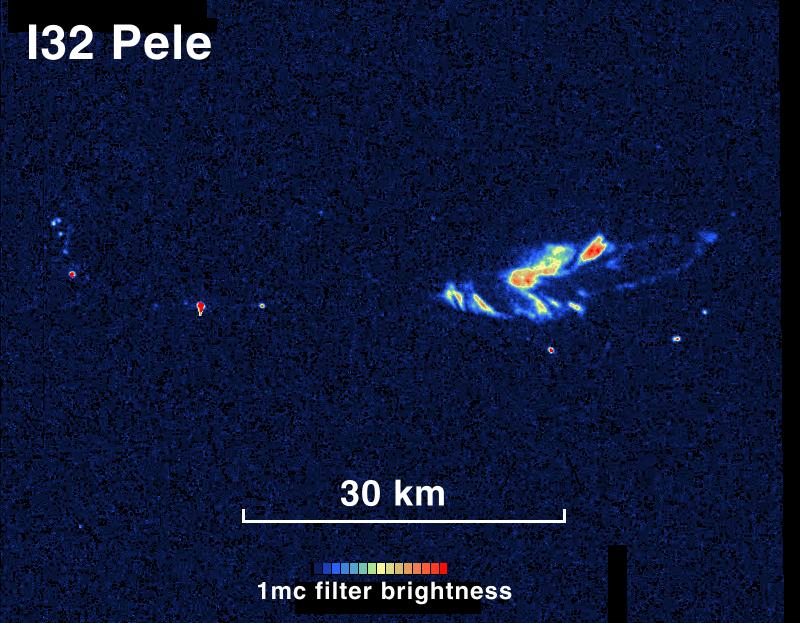
| Описание | In a high-resolution view from NASA's Galileo spacecraft, the Pele hot spot on Jupiter's moon Io shows a complex pattern of areas glowing in the dark, including areas likely to be fresh overturning of a lava lake's crust.
Hundreds of hot spots have been observed on Io, the most volcanic world in the solar system. Most previous observations have been at very low resolution. This false-color nighttime image of the Pele hot spot, acquired during Galileo's close flyby of Io in October 2001, reveals details down to 60 meters (200 feet) in length. Red indicates the most intense combination of temperature and area; blue indicates cooler materials or smaller patches of hot materials. Scientists believe the Pele hot spot has a lava lake inside a volcanic crater or caldera. The series of bright spots seen here may correspond to the edge of the caldera, where cooled crust of the lava lake is breaking up against the wall and hotter lava appears from underneath. (That pattern is seen in a lava lake in Hawaii). Alternatively, they could be fractures in the crust. Galileo acquired similar observations in October 1999 and February 2000, but the newest images are the first to show the larger bright areas seen on the right side of the image. These probably correspond to regions of vigorous overturning of the crust. Galileo acquired several nighttime images of Pele in October 2001. These may enable measurements of temperature and perhaps detection of short-term changes in the exposures of hot lava. Preliminary calculations indicate the lava temperature is about 1,400 degrees Kelvin (2,060 degrees Fahrenheit) at one location, which would be similar to the temperatures of lava erupted at Kilauea in Hawaii. North is the top of the picture. The image is centered at 18.7 degrees south latitude and 255.5 degrees west longitude. Galileo's camera took it from a distance of about 6,000 kilometers (3,700 miles) away. The Jet Propulsion Laboratory, a division of the California Institute of Technology in Pasadena, manages the Galileo mission for NASA's Office of Space Science, Washington, D.C. Additional information about Galileo and its discoveries is available on the Galileo mission home page at http://galileo.jpl.nasa.gov. Background information and educational context for the images can be found at http://galileo.jpl.nasa.gov/gallery/io.cfm. |
|---|---|
| Источник | http://photojournal.jpl.nasa.gov/catalog/PIA02596 |
| Время создания | 2001-11-27 |
| Автор или правообладатель | NASA/JPL/University of Arizona — Лицензия: Public domain (в общественном достоянии) |
| Другие версии файла | — |
Источник файла — сайт Wikimedia Commons, куда он был загружен под одной из свободных лицензий ( https://commons.wikimedia.org/wiki/File:Pele_Io_I32.jpg ). Авторов, работавших над этим файлом см. в истории файла: https://commons.wikimedia.org/w/index.php?title=File:Pele_Io_I32.jpg&action=history


В общем случае в статьях энциклопедии Руниверсалис файлы используются в соответствии со статьёй 1274 Гражданского кодекса Российской Федерации.
История файла
Нажмите на дату/время, чтобы увидеть версию файла от того времени.
| Дата/время | Миниатюра | Размеры | Участник | Примечание | |
|---|---|---|---|---|---|
| текущий | 13:09, 20 декабря 2023 | | 800 × 623 (96 КБ) | I, Robot (обсуждение | вклад) | == Описание == {{Изображение | описание = In a high-resolution view from NASA's Galileo spacecraft, the Pele hot spot on Jupiter's moon Io shows a complex pattern of areas glowing in the dark, including areas likely to be fresh overturning of a lava lake's crust. <p>Hundreds of hot spots have been observed on Io, the most volcanic world in the solar system. Most previous observations have been at very low resolution. This false-color nighttime image of the Pele hot spot, acquired during Gali... |
Вы не можете перезаписать этот файл.
Использование файла
Следующий файл является дубликатом этого файла (подробности):

- Файл:Pele Io I32.jpg на общем хранилище
Следующая страница использует этот файл:
