


Файл:NGC1156 - HST - Potw2234a.jpg


Исходный файл (2896 × 2959 пкс, размер файла: 398 КБ, MIME-тип: image/jpeg)
Описание
| Описание | A Marvel of Galactic Morphology
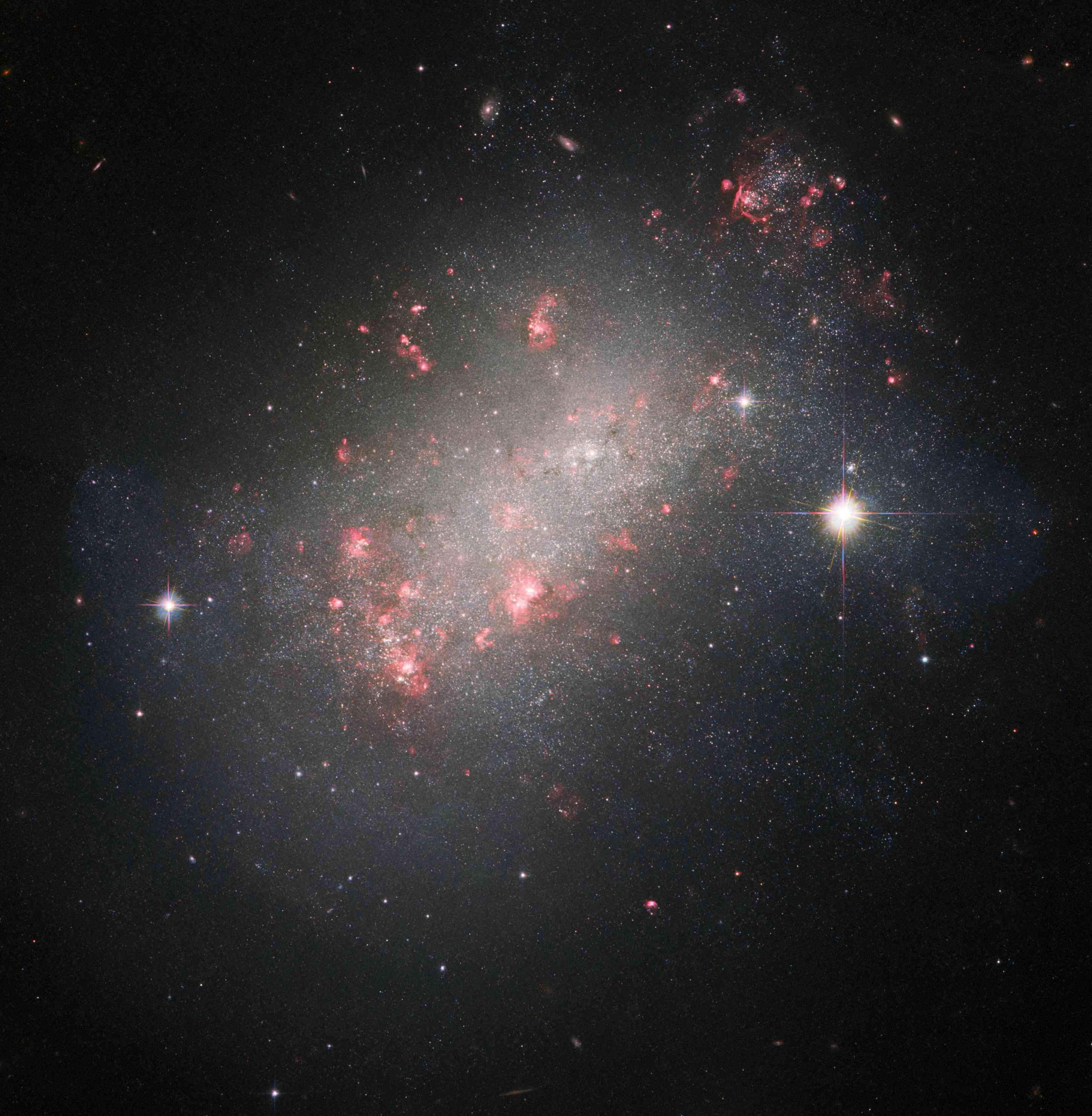
The galaxy featured in this Picture of the Week has a shape unlike many of the galaxies familiar to Hubble. Its thousands of bright stars evoke a spiral galaxy, but it lacks the characteristic ‘winding’ structure. The shining red blossoms stand out as well, twisted by clouds of dust — these are the locations of intense star formation. Yet it also radiates a diffuse glow, much like an elliptical galaxy and its core of older, redder stars. This galactic marvel is known to astronomers as NGC 1156. NGC 1156 is located around 25 million light-years from Earth, in the constellation Aries. It has a variety of different features that are of interest to astronomers. A dwarf irregular galaxy, it’s also classified as isolated, meaning no other galaxies are nearby enough to influence its odd shape and continuing star formation. The extreme energy of freshly formed young stars gives colour to the galaxy, against the red glow of ionised hydrogen gas, while its centre is densely-packed with older generations of stars. Hubble has captured NGC 1156 before — this new image features data from a galactic gap-filling programme simply titled “Every Known Nearby Galaxy”. Astronomers noticed that only three quarters of the galaxies within just over 30 million light-years of Earth had been observed by Hubble in sufficient detail to study the makeup of the stars within them. They proposed that in between larger projects, Hubble could take snapshots of the remaining quarter — including NGC 1156. Gap-filling programmes like this one ensure that the best use is made of Hubble’s valuable observing time. Credit: ESA/Hubble & NASA, R. B. Tully, R. Jansen, R. Windhorst Coordinates Position (RA): 2 59 41.66 Position (Dec): 25° 14' 18.32" Field of view: 3.02 x 3.08 arcminutes Orientation: North is 82.1° right of vertical Colours & filters Band Wavelength Telescope Optical V 606 nm Hubble Space Telescope ACS Optical r 625 nm Hubble Space Telescope ACS Optical I 814 nm Hubble Space Telescope WFPC2 Optical I 814 nm Hubble Space Telescope ACS Optical NII 658 nm Hubble Space Telescope ACS Ultraviolet UV 300 nm Hubble Space Telescope WFPC2 |
|---|---|
| Источник | https://esahubble.org/images/potw2234a/ |
| Время создания | 22 August 2022, 06:00(released) |
| Автор или правообладатель | Credit: ESA/Hubble & NASA, R. B. Tully, R. Jansen, R. Windhorst — Лицензия: CC BY 4.0 (Creative Commons Attribution 4.0) https://creativecommons.org/licenses/by/4.0 |
| Другие версии файла | — |
Источник файла — сайт Wikimedia Commons, куда он был загружен под одной из свободных лицензий ( https://commons.wikimedia.org/wiki/File:NGC1156_-_HST_-_Potw2234a.jpg ). Авторов, работавших над этим файлом см. в истории файла: https://commons.wikimedia.org/w/index.php?title=File:NGC1156_-_HST_-_Potw2234a.jpg&action=history


В общем случае в статьях энциклопедии Руниверсалис файлы используются в соответствии со статьёй 1274 Гражданского кодекса Российской Федерации.
История файла
Нажмите на дату/время, чтобы увидеть версию файла от того времени.
| Дата/время | Миниатюра | Размеры | Участник | Примечание | |
|---|---|---|---|---|---|
| текущий | 20:58, 20 ноября 2023 | | 2896 × 2959 (398 КБ) | I, Robot (обсуждение | вклад) | == Описание == {{Изображение | описание = <b>A Marvel of Galactic Morphology</b> <p>The galaxy featured in this Picture of the Week has a shape unlike many of the galaxies familiar to Hubble. Its thousands of bright stars evoke a spiral galaxy, but it lacks the characteristic ‘winding’ structure. The shining red blossoms stand out as well, twisted by clouds of dust — these are the locations of intense star formation. Yet it also radiates a diffuse glow, much like an elliptical galaxy and its... |
Вы не можете перезаписать этот файл.
Использование файла
Следующая страница использует этот файл:
