


Файл:Galileo I32 Thor SSI.png

Исходный файл (796 × 796 пкс, размер файла: 383 КБ, MIME-тип: image/png)
Описание
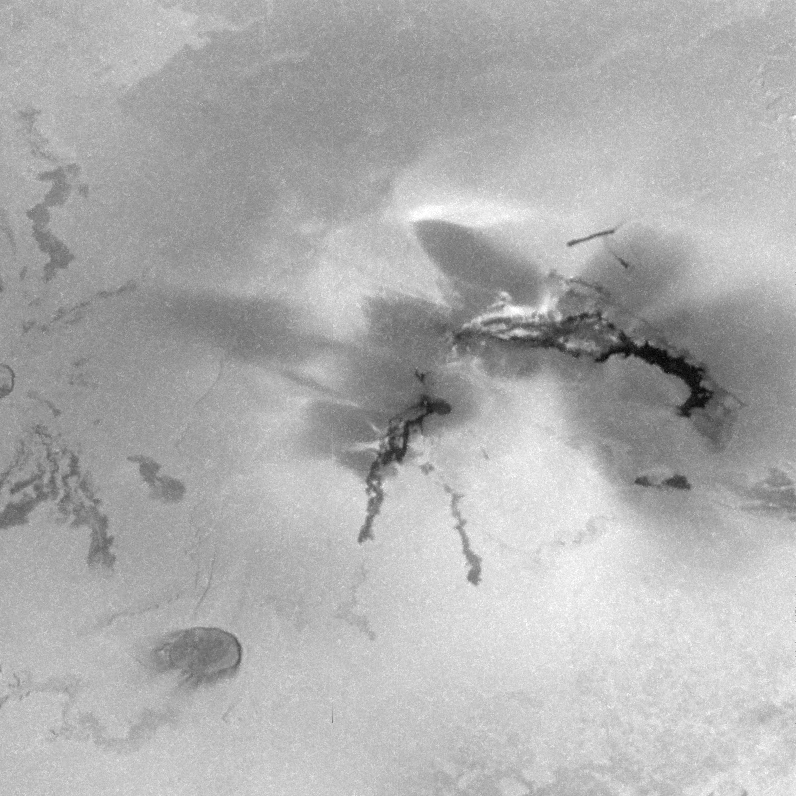
| Описание | Image of the Thor volcano by Galileo taken in October 2001. Thor was officially by the International Astronomical Union in 2006, after the publication of the original caption. This image data is discussed, along with the Thor plume in this image, in Turtle, E. P.; et al. (2004). "The final Galileo SSI observations of Io: orbits G28-I33". Icarus 169: 3–28. doi:10.1016/j.icarus.2003.10.014.
Original caption:The source area of what had been a towering volcanic plume two months earlier lies in the far-right frame of this mosaic of images taken of Jupiter's moon Io by NASA's Galileo spacecraft on Oct. 16, 2001. The region in the images includes the Zamama lava flow in Jupiter's northern hemisphere. The Zamama flow field emanates from the northernmost of two small volcanoes in the far left frame. These lava flows were not present in Voyager images of Io, so they formed some time between the Voyager 1 flyby in 1979 and the first Galileo observations of Io in 1996. Galileo also observed Zamama during Io encounters in 1999, and scientists identified narrow, long, dark lava flows thought to be similar to lava flows in Hawaii. Moving northeast, the second and third frames of this mosaic contain lava flow fields and several unnamed volcanic depressions, called "paterae." It is unclear whether the broad, shield-like features or plateaus on which the paterae rest were created by eruptions from the paterae, or if they were preexisting features. Some fractures and dark lines suggest that the crust here is breaking up, creating cracks that magma can use to rise to the surface. The far-right frame of this mosaic shows dark lava flows and bright spots. The bright spots are probably sulfur-bearing plume deposits, which are thought to be associated with the source of a plume eruption 500 kilometers (310 miles) high that was observed by the Galileo spacecraft in August, 2001. It was the largest plume eruption ever observed on Io. The Jet Propulsion Laboratory, a division of the California Institute of Technology in Pasadena, manages the Galileo mission for NASA's Office of Space Science, Washington, D.C. Additional information about Galileo and its discoveries is available on the Galileo mission home page at http://galileo.jpl.nasa.gov. Background information and educational context for the images can be found at http://galileo.jpl.nasa.gov/gallery/io.cfm. |
|---|---|
| Источник | http://photojournal.jpl.nasa.gov/catalog/PIA03531 |
| Время создания | 2002-05-28 |
| Автор или правообладатель | NASA/JPL/University of Arizona — Лицензия: Public domain (в общественном достоянии) |
| Другие версии файла | — |
Источник файла — сайт Wikimedia Commons, куда он был загружен под одной из свободных лицензий ( https://commons.wikimedia.org/wiki/File:Galileo_I32_Thor_SSI.png ). Авторов, работавших над этим файлом см. в истории файла: https://commons.wikimedia.org/w/index.php?title=File:Galileo_I32_Thor_SSI.png&action=history


В общем случае в статьях энциклопедии Руниверсалис файлы используются в соответствии со статьёй 1274 Гражданского кодекса Российской Федерации.
История файла
Нажмите на дату/время, чтобы увидеть версию файла от того времени.
| Дата/время | Миниатюра | Размеры | Участник | Примечание | |
|---|---|---|---|---|---|
| текущий | 12:06, 12 октября 2023 | | 796 × 796 (383 КБ) | Я, робот (обсуждение | вклад) | == Описание == {{Изображение | описание = Image of the Thor volcano by <i>Galileo</i> taken in October 2001. Thor was officially by the International Astronomical Union in 2006, after the publication of the original caption. This image data is discussed, along with the Thor plume in this image, in Turtle, E. P.; et al. (2004). "The final Galileo SSI observations of Io: orbits G28-I33". Icarus 169: 3–28. doi:[https://dx.doi.org/10.1016/j.icarus.2003.10.014 10.1016/j.icarus.2003.10.014]. <h3... |
Вы не можете перезаписать этот файл.
Использование файла
Следующий файл является дубликатом этого файла (подробности):

- Файл:Galileo I32 Thor SSI.png на общем хранилище
Следующая страница использует этот файл:
