


Файл:Egyptian - Scarab - Walters 42376 - Bottom.jpg

Исходный файл (1264 × 1800 пкс, размер файла: 1,17 МБ, MIME-тип: image/jpeg)
Описание
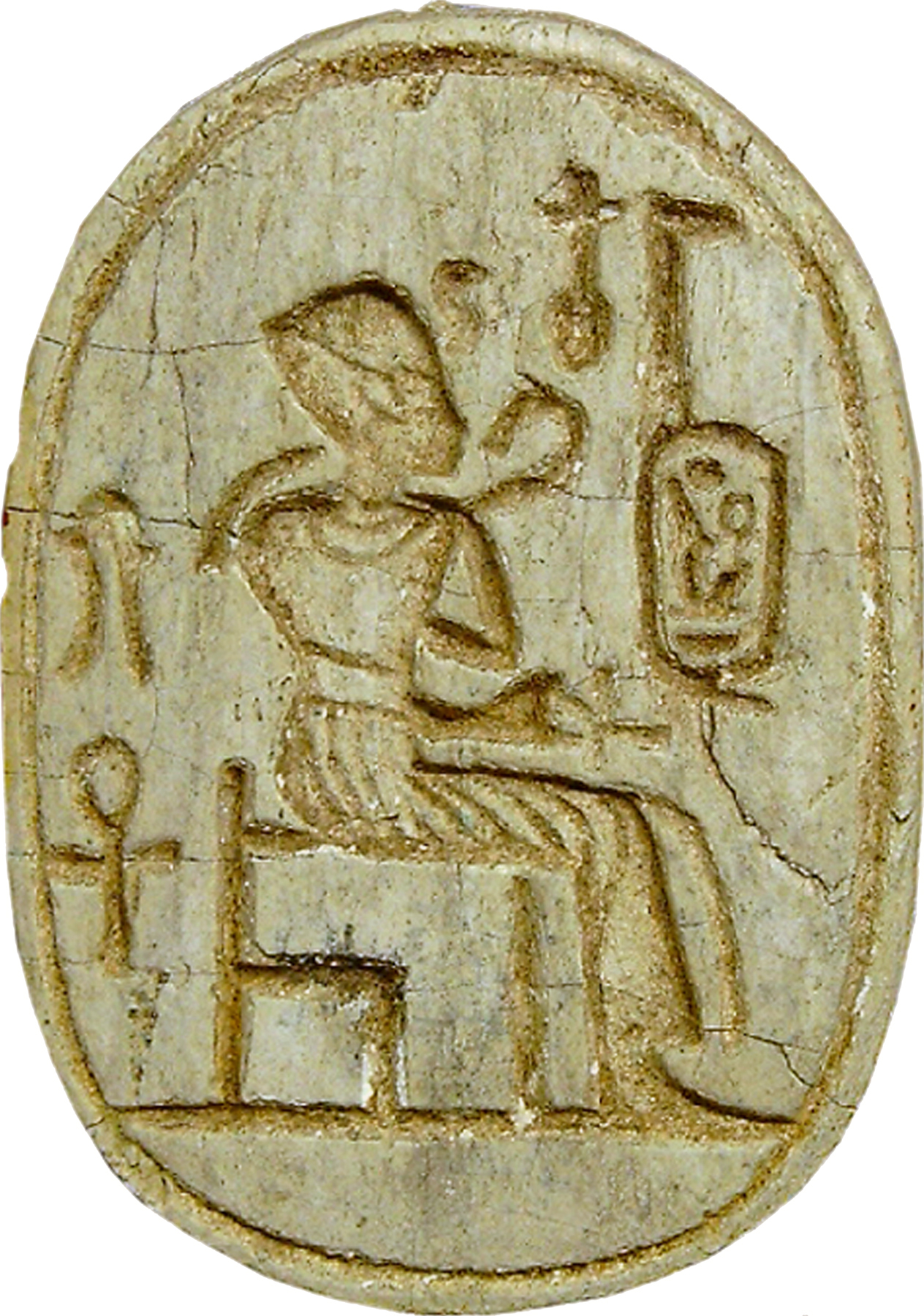
| Описание | The ancient Egyptians believed that the dung beetle, the Scarabaeus sacer, was one of the manifestations of the sun god. Representations of these beetles were used as amulets, and for ritual or administrative purposes.
This scarab has a bottom design that displays King Amenhotep III seated on his throne. He is dressed in a long pleated shendyt, wears the so-called "Blue crown" with Uraeus-serpent and crown sash. The king holds with his left hand the crook in front of his chest, and with his right an ankh-sign (meaning "life"). The block throne has a small back. In front of him is a column with a left reading inscription, containing his throne name and title, and behind him the hieroglyphs for "protection" and "life." The layout is well organized, but it is notable that the royal figure does not fill the whole space, and that the Uraeus on the forehead of the king is unusually large. The highest point of the scarab's back is the pronotum (dorsal plate of the prothorax). Pronotum and elytron (wing cases) have deeply incised, fine borderlines, single separation lines, V-shaped marks for the humeral callosities (shoulder thickenings), and small side-depressions. The partition lines between pronotum and elytron meet V-shaped. The rectangular head is flanked by triangular eyes. The trapezoidal side plates have curved outer edges and borderlines, and the clypeus (front plate) has four frontal serrations and two central base notches. The raised, slender extremities have natural form; the background between the legs is deeply hollowed out. The low oval base is symmetrical. The scarab is longitudinally pierced, was originally mounted or threaded, and functioned as an amulet. It secures the existence ("life"), protection, divinity (title: "Perfect god"), and royal authority (cartouche, seated king with scepter) for the king, and provides a private owner with his patronage and protection. |
|---|---|
| Источник | Walters Art Museum: [1] Home page [2] Info about artwork |
| Время создания | between 1388 and 1351 BC (New Kingdom of Egypt) |
| Автор или правообладатель |
Anonymous (Egypt) — Лицензия: Public domain (в общественном достоянии)
|
| Другие версии файла | — |
Источник файла — сайт Wikimedia Commons, куда он был загружен под одной из свободных лицензий ( https://commons.wikimedia.org/wiki/File:Egyptian_-_Scarab_-_Walters_42376_-_Bottom.jpg ). Авторов, работавших над этим файлом см. в истории файла: https://commons.wikimedia.org/w/index.php?title=File:Egyptian_-_Scarab_-_Walters_42376_-_Bottom.jpg&action=history


В общем случае в статьях энциклопедии Руниверсалис файлы используются в соответствии со статьёй 1274 Гражданского кодекса Российской Федерации.
История файла
Нажмите на дату/время, чтобы увидеть версию файла от того времени.
| Дата/время | Миниатюра | Размеры | Участник | Примечание | |
|---|---|---|---|---|---|
| текущий | 20:08, 10 октября 2023 | | 1264 × 1800 (1,17 МБ) | Я, робот (обсуждение | вклад) | == Описание == {{Изображение | описание = The ancient Egyptians believed that the dung beetle, the Scarabaeus sacer, was one of the manifestations of the sun god. Representations of these beetles were used as amulets, and for ritual or administrative purposes. <p>This scarab has a bottom design that displays King Amenhotep III seated on his throne. He is dressed in a long pleated shendyt, wears the so-called "Blue crown" with Uraeus-serpent and crown sash. The king holds with his left hand t... |
Вы не можете перезаписать этот файл.
Использование файла
Следующий файл является дубликатом этого файла (подробности):

- Файл:Egyptian - Scarab - Walters 42376 - Bottom.jpg на общем хранилище
Следующая страница использует этот файл:
