


Файл:Ear Mound Sign.jpg
Исходный файл (3848 × 2268 пкс, размер файла: 1,09 МБ, MIME-тип: image/jpeg)
Описание
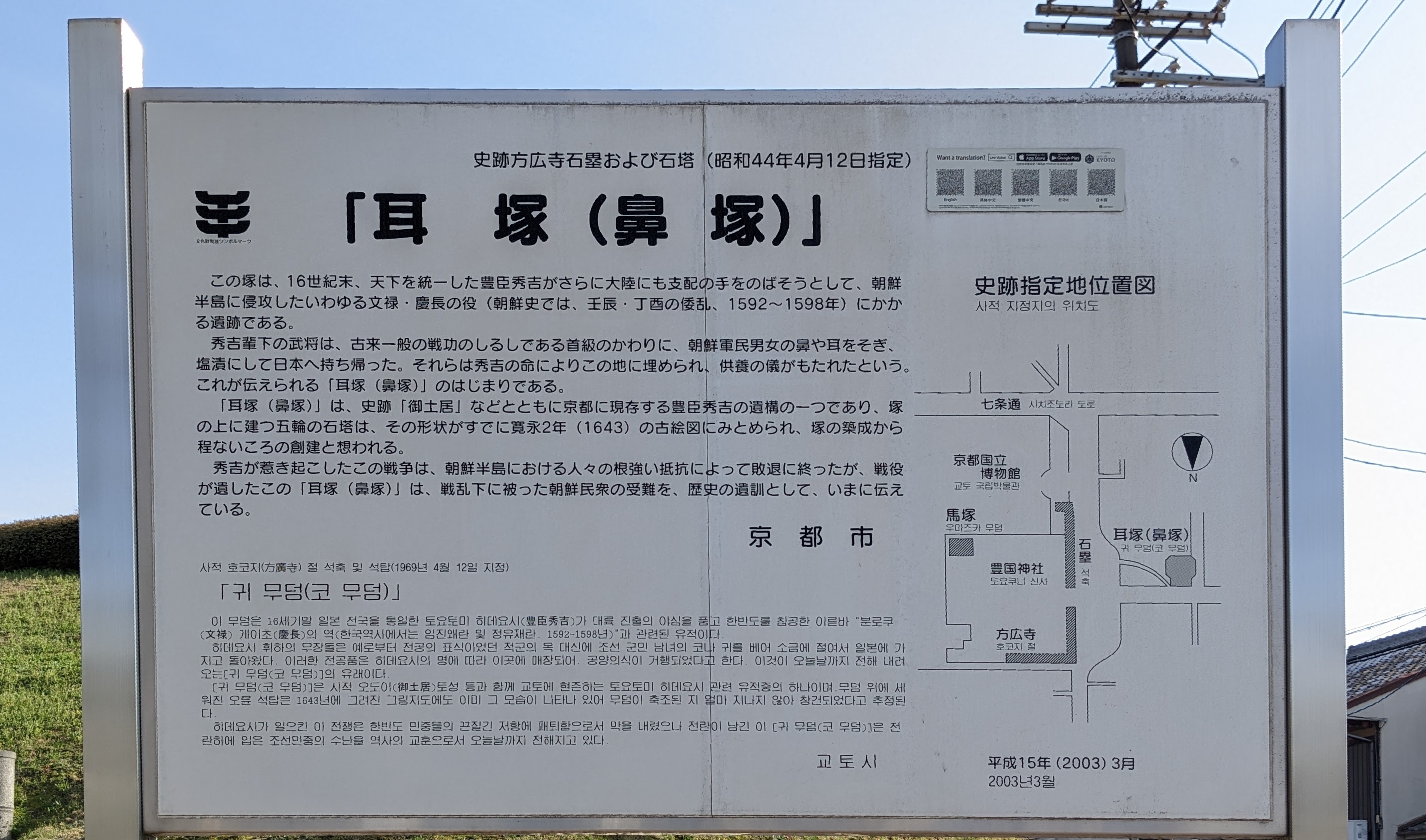
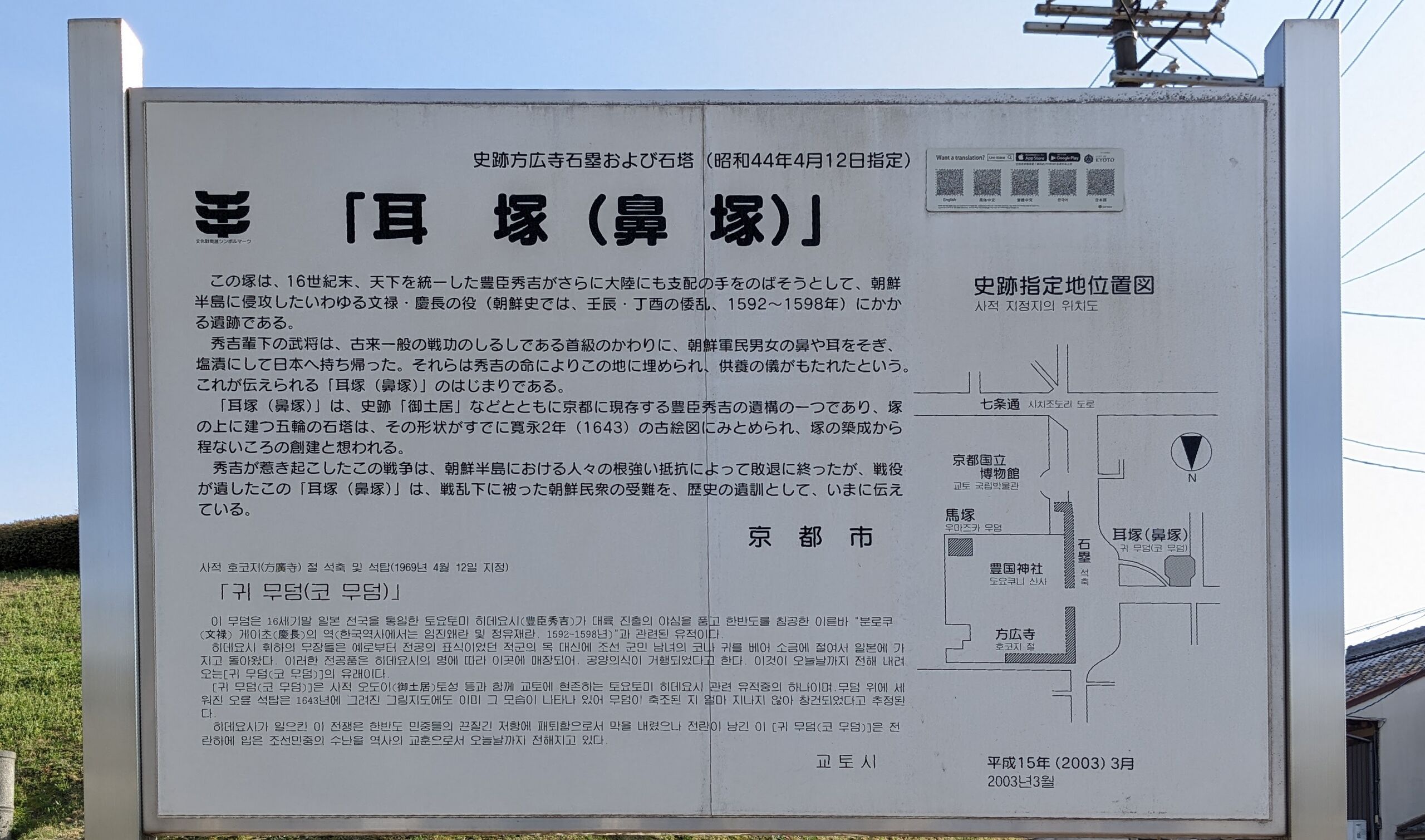
| Описание | Sign in front of Mimizuka, with text in Japanese and Korean. English Translation of Japanese Text:
Historic Site Hokoji Stone Wall and Stone Pagoda (Designated April 12, Year 44 of Showa Era [1969]) "Ear Mound (Nose Mound)" This mound was built at the end of the 16th century, during the Bunroku and Keicho War (in Korean history, the Wa of Imshin and Chori), when Toyotomi Hideyoshi, who unified Japan, invaded the Korean peninsula in an attempt to extend his control to the continent. These are remnants of the Rebellion (1592-1598). Military commanders under Hideyoshi cut off the noses and ears of Korean military and civilian men and women, salted them, and brought them back to Japan, rather than using their heads, which had traditionally been a mark of military merit. It is said that they were buried in this area by order of Hideyoshi, and a memorial service was held. This is the origin of the "Ear Mound (Nose Mound)," and is one of the remaining historical sites of Toyotomi Hideyoshi that still exists in Kyoto, along with Odoi Castle. The five-ringed stone pagoda that stands on top of the mound was already visible in a pictorial map drawn in 1643. It is presumed that it was built shortly after the tomb. This war, which was started by Hideyoshi, ended in defeat due to the persistent resistance of the people on the Korean peninsula, but the "Ear Mound (Nose Mound)" remains to this day and serves as a lesson in history about the suffering of the Korean people during the war. Kyoto City |
|---|---|
| Источник | Own work |
| Время создания | 2023-03-29 |
| Автор или правообладатель | Epachamo — Лицензия: CC BY-SA 4.0 (Creative Commons Attribution-Share Alike 4.0) https://creativecommons.org/licenses/by-sa/4.0 |
| Другие версии файла | — |
Источник файла — сайт Wikimedia Commons, куда он был загружен под одной из свободных лицензий ( https://commons.wikimedia.org/wiki/File:Ear_Mound_Sign.jpg ). Авторов, работавших над этим файлом см. в истории файла: https://commons.wikimedia.org/w/index.php?title=File:Ear_Mound_Sign.jpg&action=history


В общем случае в статьях энциклопедии Руниверсалис файлы используются в соответствии со статьёй 1274 Гражданского кодекса Российской Федерации.
История файла
Нажмите на дату/время, чтобы увидеть версию файла от того времени.
| Дата/время | Миниатюра | Размеры | Участник | Примечание | |
|---|---|---|---|---|---|
| текущий | 09:34, 2 августа 2024 | | 3848 × 2268 (1,09 МБ) | Я, робот (обсуждение | вклад) | == Описание == {{Изображение | описание = Sign in front of Mimizuka, with text in Japanese and Korean. English Translation of Japanese Text: <p>Historic Site Hokoji Stone Wall and Stone Pagoda (Designated April 12, Year 44 of Showa Era [1969]) </p><p>"Ear Mound (Nose Mound)" </p><p>This mound was built at the end of the 16th century, during the Bunroku and Keicho War (in Korean history, the Wa of Imshin and Chori), when Toyotomi Hideyoshi, who unified Japan, invaded the Korean peninsula in a... |
Вы не можете перезаписать этот файл.
Использование файла
Следующий файл является дубликатом этого файла (подробности):

- Файл:Ear Mound Sign.jpg на общем хранилище
Следующая страница использует этот файл:
