


Файл:Caldwell 43.jpg

Исходный файл (1920 × 954 пкс, размер файла: 376 КБ, MIME-тип: image/jpeg)
Описание
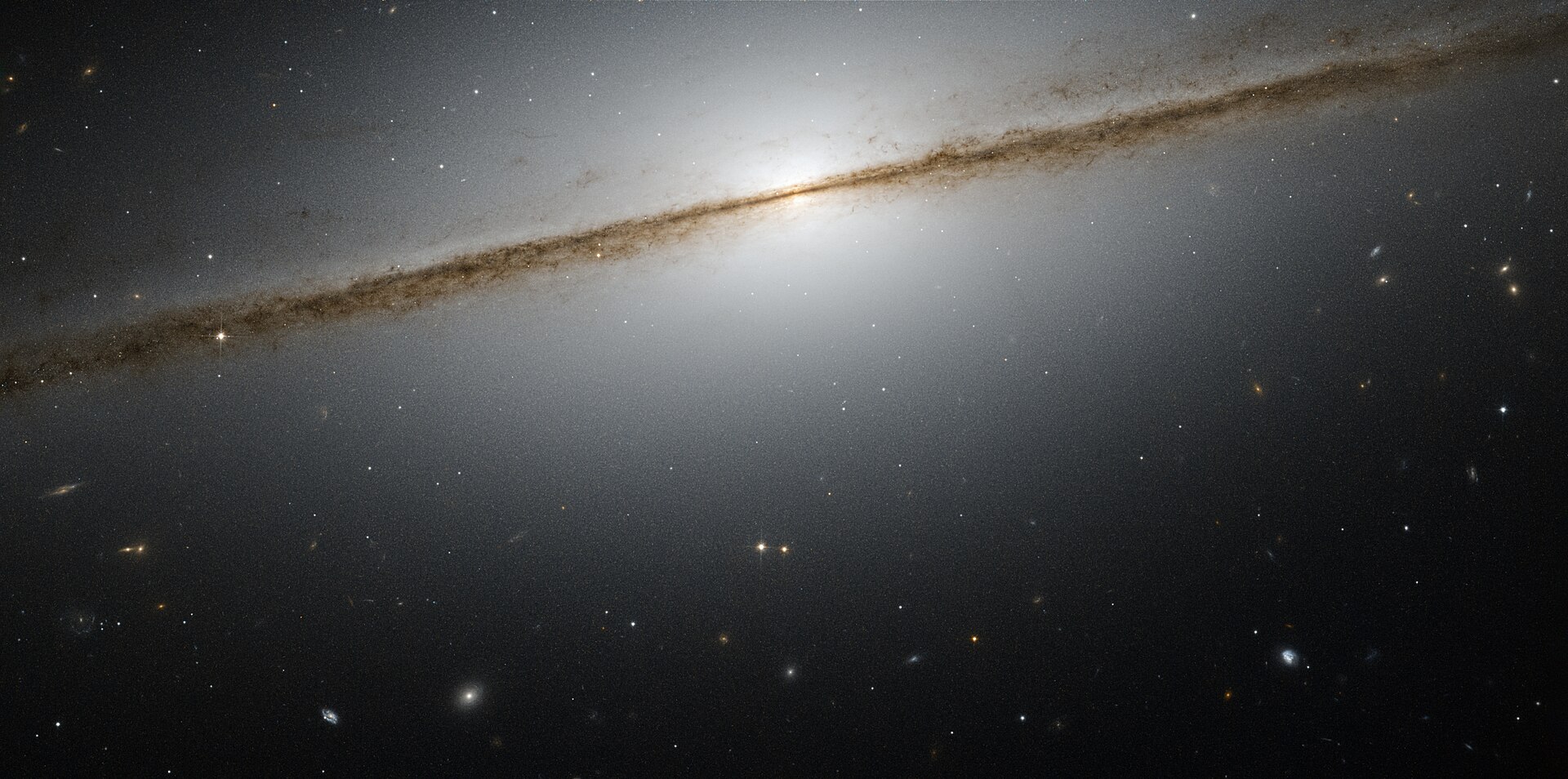
| Описание | Hubble has allowed astronomers to view galaxies of all shapes and sizes from nearly every angle. When a galaxy is seen edge-on, the mesmerizing perspective reveals a dazzling slice of the universe. Caldwell 43, also known as the “Little Sombrero,” is one such galaxy.
Set against a speckled backdrop of more remote galaxies, Caldwell 43 features a bright central bulge, a thin disk full of dust, and a glowing halo of gas and stars that sprawls out into space. The Little Sombrero was first discovered by British astronomer William Herschel in 1784. The dusty spiral gets its nickname from the Sombrero galaxy (M104), which resembles a broad-rimmed Mexican hat and was discovered by the French astronomer Pierre Méchain just a few years earlier in 1781. Also viewed from its edge, the Sombrero galaxy is located just 28 million light-years away and looks larger than the Little Sombrero. In reality, they are nearly the same size. The Sombrero appears bigger because it is closer. With a magnitude of 10.5, the Little Sombrero is tougher to spot because it is farther away, at a distance of 40 million light-years from Earth. Also known as NGC 7814, the roughly 80,000-light-year-wide galaxy is billions of years old. Observers equipped with a telescope at least 7 inches in diameter will have the best luck spotting the galaxy, which resides in the constellation Pegasus. The dim, elongated galaxy is bright enough to be seen in moderately light-polluted skies. In the Northern Hemisphere, the autumn months provide the best opportunity to view Caldwell 43. In the Southern Hemisphere, look for it in the springtime. This image of Caldwell 43 is a combination of visible and infrared observations captured by Hubble’s Advanced Camera for Surveys in 2006. The observations were taken to assist astronomers in studying the galaxy’s stellar populations, and to help shed light on the evolution of this galaxy and others like it. For more information about Hubble’s observations of Caldwell 43, see: www.spacetelescope.org/images/potw1505a/ Credit: ESA/Hubble & NASA; Acknowledgment: Josh Barrington For Hubble's Caldwell catalog site and information on how to find these objects in the night sky, visit: www.nasa.gov/content/goddard/hubble-s-caldwell-catalog |
|---|---|
| Источник | https://www.flickr.com/photos/144614754@N02/49201143797/ |
| Время создания | 2015-02-02 10:00:00 |
| Автор или правообладатель | NASA Hubble — Лицензия: CC BY 2.0 (Creative Commons Attribution 2.0) https://creativecommons.org/licenses/by/2.0 |
| Другие версии файла | — |
Источник файла — сайт Wikimedia Commons, куда он был загружен под одной из свободных лицензий ( https://commons.wikimedia.org/wiki/File:Caldwell_43.jpg ). Авторов, работавших над этим файлом см. в истории файла: https://commons.wikimedia.org/w/index.php?title=File:Caldwell_43.jpg&action=history


В общем случае в статьях энциклопедии Руниверсалис файлы используются в соответствии со статьёй 1274 Гражданского кодекса Российской Федерации.
История файла
Нажмите на дату/время, чтобы увидеть версию файла от того времени.
| Дата/время | Миниатюра | Размеры | Участник | Примечание | |
|---|---|---|---|---|---|
| текущий | 15:40, 29 августа 2026 | | 1920 × 954 (376 КБ) | Бот Инок (обсуждение | вклад) |
Вы не можете перезаписать этот файл.
Использование файла
Следующая страница использует этот файл:
