


Файл:Caldwell 23 - 2.jpg


Исходный файл (3077 × 3196 пкс, размер файла: 138 КБ, MIME-тип: image/jpeg)
Описание
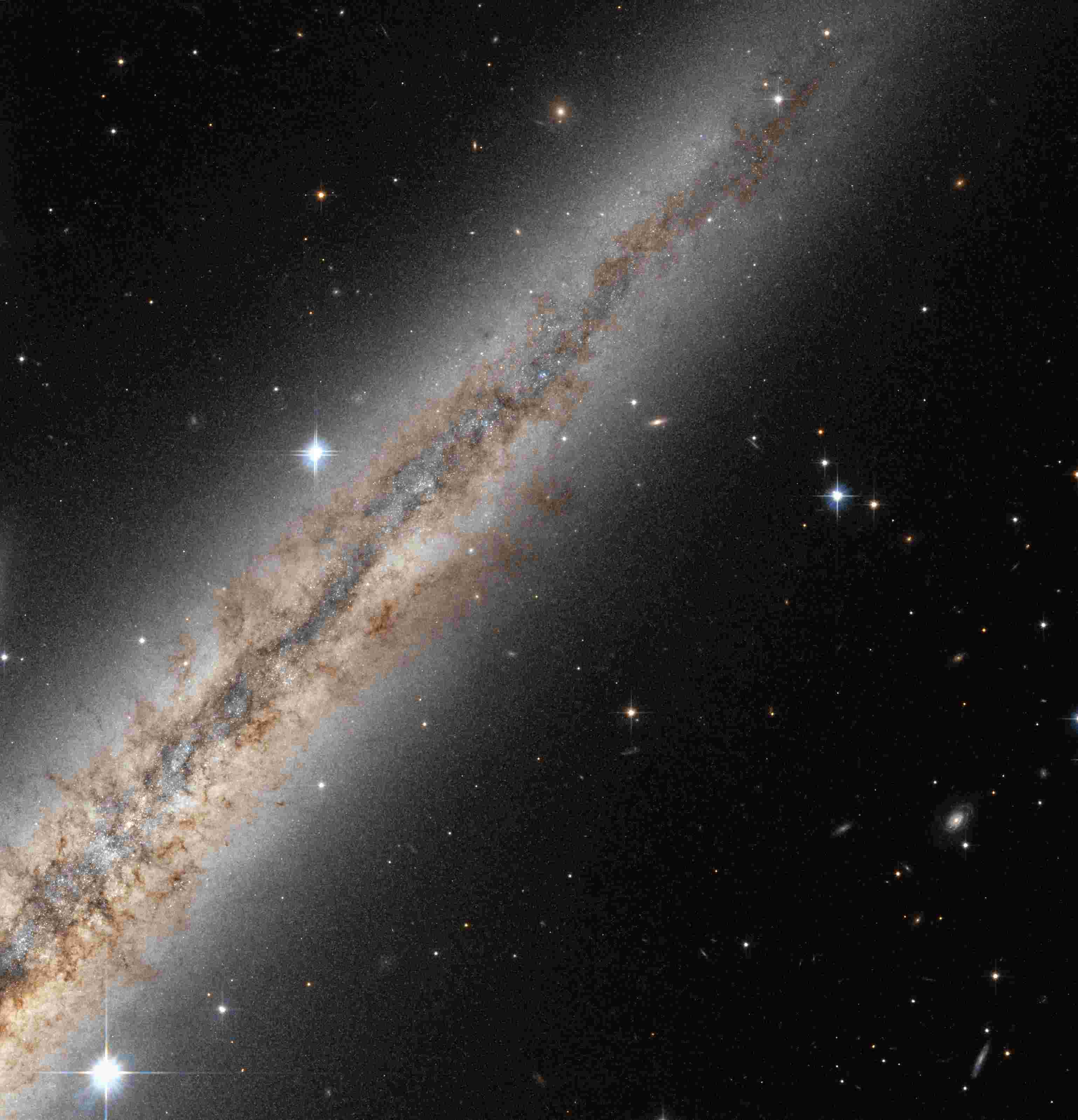
| Описание | If we could travel across space and time to see our own galaxy from the outside looking in, it would probably look a lot like Caldwell 23. This spiral galaxy, also cataloged as NGC 891, is about 35 million light-years away from Earth in the constellation Andromeda. Sir Patrick Moore, creator of the Caldwell catalog, once said the full galaxy looks like “two fried eggs clapped back to back.” In this Hubble image, taken in visible and infrared light using the Advanced Camera for Surveys, the “yolk” portion of the galaxy is out of the picture beyond the lower left corner. A few foreground stars from the Milky Way shine brightly, while more-distant galaxies can be seen in the lower right corner of the image.
Astronomers used Hubble’s observations of Caldwell 23 to learn more about the structure and evolution of spiral galaxies. One of their findings helped identify the source of Caldwell 23’s galactic “halo.” The halo surrounds the galaxy and primarily contains old stars, some of which are grouped together in large, sphere-shaped collections called globular clusters. The source of this halo material has been unclear, since theoretically it could either originate in the galaxy or be gravitationally pulled in from the area surrounding the galaxy. Scientists using Hubble found that Caldwell 23’s halo is similar in composition to other material in the galaxy, which suggests that the halo material was expelled from within the galaxy. This Hubble image shows wispy tendrils of dust and gas branching off from the plane of the galaxy into the halo. Astronomers believe these structures formed as material was ejected outward by supernovae or intense star formation activity. When massive stars light up at birth or explode at death, they produce powerful winds that can blow dust and gas over hundreds of light-years of space. Caldwell 23 was discovered by astronomer William Herschel in October 1784. The galaxy has a magnitude of 10, so use a telescope to see it, away from any sources of light pollution. Under ideal conditions you can make out the galaxy’s central dark lane. Autumn night skies in the Northern Hemisphere will provide the best view. In the Southern Hemisphere, look for Caldwell 23 in the springtime. For more information about Hubble’s observations of Caldwell 23, see: www.spacetelescope.org/images/potw1220a/ hubblesite.org/contents/news-releases/1999/news-1999-10.html Credit: ESA/Hubble & NASA; Acknowledgement: Nick Rose For Hubble's Caldwell catalog site and information on how to find these objects in the night sky, visit: www.nasa.gov/content/goddard/hubble-s-caldwell-catalog |
|---|---|
| Источник | https://www.flickr.com/photos/144614754@N02/49164938063/ |
| Время создания | 2012-05-14 10:00:00 |
| Автор или правообладатель | NASA Hubble — Лицензия: CC BY 2.0 (Creative Commons Attribution 2.0) https://creativecommons.org/licenses/by/2.0 |
| Другие версии файла | — |
Источник файла — сайт Wikimedia Commons, куда он был загружен под одной из свободных лицензий ( https://commons.wikimedia.org/wiki/File:Caldwell_23_-_2.jpg ). Авторов, работавших над этим файлом см. в истории файла: https://commons.wikimedia.org/w/index.php?title=File:Caldwell_23_-_2.jpg&action=history


В общем случае в статьях энциклопедии Руниверсалис файлы используются в соответствии со статьёй 1274 Гражданского кодекса Российской Федерации.
История файла
Нажмите на дату/время, чтобы увидеть версию файла от того времени.
| Дата/время | Миниатюра | Размеры | Участник | Примечание | |
|---|---|---|---|---|---|
| текущий | 13:52, 24 сентября 2023 | | 3077 × 3196 (138 КБ) | Я, робот (обсуждение | вклад) | == Описание == {{Изображение | описание = If we could travel across space and time to see our own galaxy from the outside looking in, it would probably look a lot like Caldwell 23. This spiral galaxy, also cataloged as NGC 891, is about 35 million light-years away from Earth in the constellation Andromeda. Sir Patrick Moore, creator of the Caldwell catalog, once said the full galaxy looks like “two fried eggs clapped back to back.” In this Hubble image, taken in visible and infrared light us... |
Вы не можете перезаписать этот файл.
Использование файла
Следующая страница использует этот файл:
